


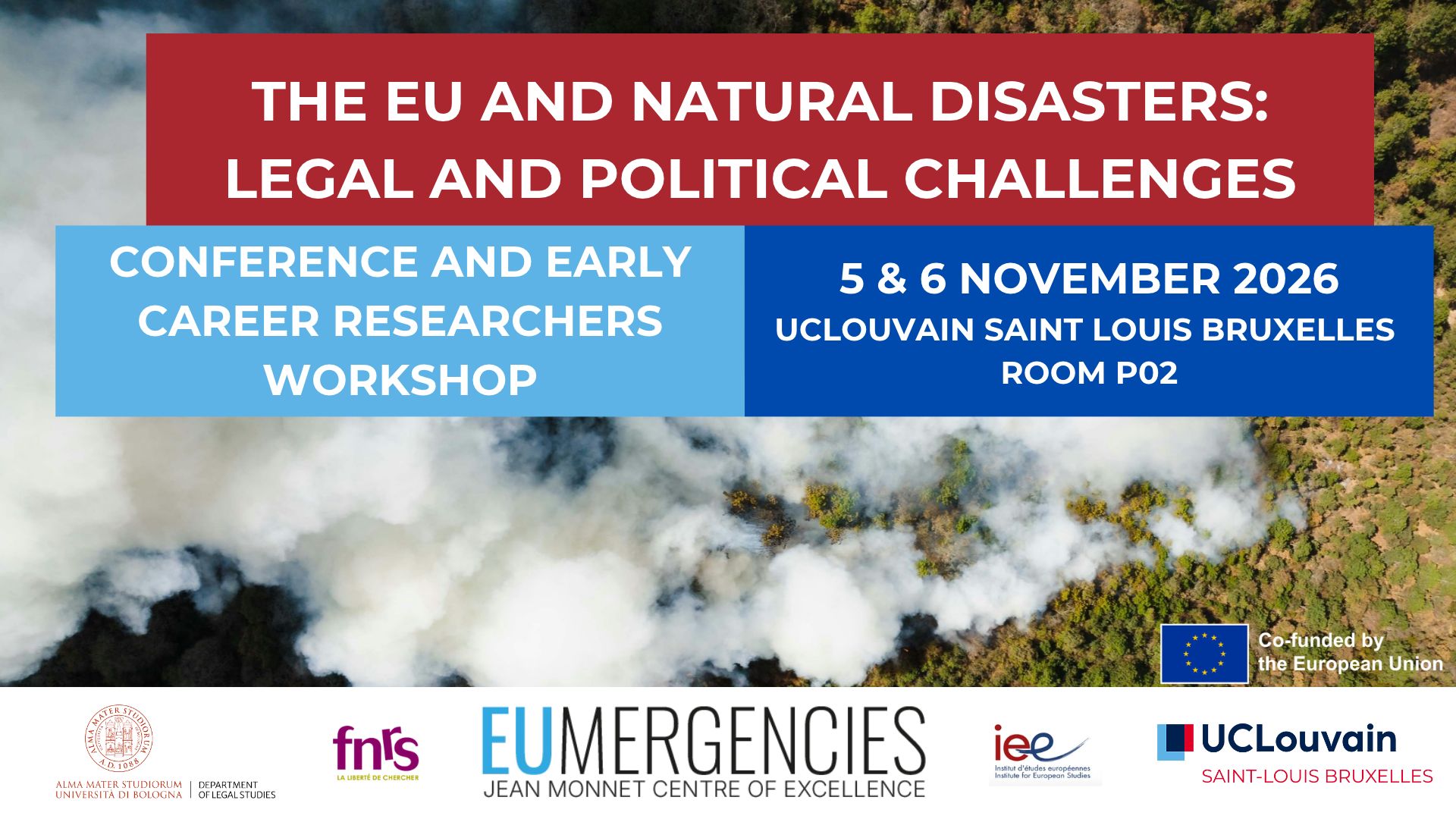
[Conference & Doctoral Workshop] The European Union and Natural Disasters
Introduction
Climate change is increasing the frequency, intensity, and complexity of extreme weather events leading to disasters. In Europe alone, around 87 million people are exposed to multiple natural hazards. Yet, the role of the European Union in this field remains far from clear-cut.
On the one hand, the prevention and response to disasters induced by natural hazards (often referred to as natural disasters) remain primary responsibilities of the Member States, notwithstanding the EU’s growing competence in this field through subsequent reforms of the Union Civil Protection Mechanism and the introduction of rescEU.
On the other hand, EU powers in this respect are institutionally and legally fragmented across the multitude of policy areas that the prevention and response to these disasters might criss-cross — from civil protection to humanitarian aid, climate, health or migration policy, security and defence or external relations.
Internationally, the EU has been participating actively in eWorts towards the adoption of the first binding instrument on the protection of persons in the event of disasters and in forging partnerships with diWerent actors for the delivery of humanitarian aid, raising questions about its influence, cooperation arrangements, and the degree to which the EU’s approach to (natural) disaster management shapes and is shaped by events beyond the EU.
Against this background, this conference invites a multidisciplinary dialogue on the law, politics, and governance of disasters induced by natural hazards in the EU and the role of the EU as an international disaster relief actor. Topics of interest include, but are not limited to:
- Conceptual and contextual issues: pertaining to the understanding ‘natural’ disasters as (extra)ordinary events and to the legal and political categorisation of diWerent disasters, the notion of polycrisis and vulnerability with respect to disasters induced by natural hazards, and the role of sovereignty and solidarity in international and EU approaches to such disasters.
- Institutional and constitutional issues: pertaining to the distribution of competences between the EU and its Member States, Member States’ obligations with respect to disasters
induced by natural hazards, and the role of diWerent institutions and actors in the prevention of, and response to, such disasters. - Policy-specific issues: pertaining to developments in the field of civil protection and humanitarian aid, the intersection between natural disasters and EU emergency powers, EU
climate, health, and migration policy, environmental security, and its implications for the coherence or fragmentation of EU disaster governance. - External action issues: pertaining to the EU’s cooperation with third states and international organisations, the EU’s influence on the development of international disaster
norms and practices, and third countries and international organisations’ influence on EU disaster management rules and practices.
Programme
PhD and Early Career Researcher Workshop (Thursday, 5 November 2026)
- 9:00 Welcome coffee and registration
- 9:15 Welcome address (Organising Committee)
- 09:30 –11:00 Panel 1. Framing the EU’s external governance of natural hazard-induced disasters
Chair and discussant: Federico Casolari (University of Bologna)- The EU’s Humanitarian Aid policy towards natural disasters: A Social Network Analysis between 2016-2025 (Alexandre Piron and Christopher Crellin, ISPOLE UCLouvain, Belgium)
- Between Norm-Exporter and Norm-Taker: The European Union and the Emergence of a Binding International Disaster Law (Roberta Leale, LUISS Guido Carli University, Rome)
- The EU as an International Disaster Responder: Humanitarian Principles and External Action in the 2023 Syrian Earthquake Response (Hasan Ogredik, University of Exeter, United Kingdom)
- 11:00-11:30 Coffee break
- 11:30-13:15 Panel 2. Climate and natural hazard-induced disasters
Chair and discussant: Chloé Brière, Université Libre de Bruxelles (ULB)- Constructing the self and producing otherness: a poststructuralist discourse analysis of the EU’s Climate-Security approach (Matthias Rétel, UCLouvain Saint-Louis Bruxelles)
- Climate related displacement in EU law and policy (Adeodata Kanyamihanda, University of Antwerp)
- France’s failures and EU’s legal shortcomings in disaster governance: Cyclone Chido in Mayotte (Ignacio Portela Giraldez, University of New South Wales)
- Natural disasters and criminal liability (Mario Pesciarelli, University of Bologna)
- 13:15 – 14:30 Lunch
- 14h30-16h15 Panel 3. Operationalising the EU’s response to natural hazard-induced disasters
Chair and discussant: Romain Foucart (University of Angers)- Framing Spontaneous Volunteers in Disaster Response: A Literature Review (Emmeline Roeloffs, Vrije Universiteit Amsterdam)
- Natural Disasters and B2G Data Sharing: Critical Issues in the “Digital Omnibus” Reform of the Data Act (Daniele Sborlini, University of Bologna)
- Emergency-bound Data Governance in the EU: Limits of the Data Act and Digital Omnibus amendments for Disaster Risk Reduction (Chiara Miozzo, University of Bologna)
- From Policy Architecture to Cognitive Practice: Examining the Gap in EU Disaster Risk Management Education (Annika Fröwis, University of Vienna)
- 16h15-16h45 Closing address (Speaker to be confirmed & Organising Committee)
- 8:30 Welcome coffee and registration
- 09:00-09:30 Keynote address (speaker tbc)
- 9:30 –11:00 Panel 1. Framing the EU’s governance of natural hazard-induced disasters
Chair: Andrea Ott (University of Maastricht)- Towards a Reconceptualization of Natural Disasters in International Law: What Implications for the EU’s Emergency-Oriented Approach? (Federica Passarini, University of Tuscia)
- From Civil Protection to Health Emergency Preparedness? The Transformation of EU Disaster Governance after Covid-19 (Michele Migliori, European Policy Centre, Brussels)
- Federico Casolari’s paper, University of Bologna
- Teresa Cabrita and Denis Duez‘s paper, UCLouvain Saint-Louis Bruxelles
- 11:00-11:30 Coffee-break
- 11:30-13:00 Panel 2. Fault lines in EU disaster governance: anticipating disasters
Chair: Jean-Louis de Brouwer (Egmont Institute)- The Emergency Events Database (EM-DAT) as the world’s collective disaster memory: data, methods, and use (Elena Briones Alonso, UCLouvain-Brussels)
- From Data to Decisions: The Implementation Gap in EU Disaster Response (Aikaterini Beli, Alessandro Paciaroni, Mpampis Chatzimallis, Lisbon Council – Brussels)
- EU Circular Economy Law as Preventive Legal Infrastructure in Natural Disaster Governance (Francesco Deana, University of Udine)
- Integrated wildfire risk management in the European Union as part of the civil protection policy. Where are we going, and how did we get here? (Romain Foucart, University of Angers)
- 13:00- 14:30 Lunch
- 14:30 – 16:00 Panel 3. Fault lines in EU disaster governance: vulnerability and the aftermath of disasters
Chair: Miriam Alba Reina (Red Cross EU Office)- From Crisis Response to Structural Knowledge: Rethinking EU Disaster Governance through Long-Term Analysis (Davide Olori, University of Milan-Bicocca)
- Beyond Aid Delivery: Political Dynamics and Access to Humanitarian Assistance in Hatay Following the 6 February 2023 Earthquakes (Hatice Nihan Sarihan, United Nations University Institute on Comparative Regional Integration Studies UNU-CRIS – Bruges, and Yiğit Göktuğ Torun, Friedrich Naumann Foundation – Istanbul)
- Belonging, Vulnerability and Disaster Governance: Human Rights Challenges in Informal Roma Settlements Exposed to Natural Hazards (Ivan Allegranti and Sára Kiššová, Comenius University, Bratislava)
- 16:00 – 16:30 Closing address (Organising Committee)
- Date: 5–6 November 2026
- Location: UCLouvain Saint-Louis Brussels Campus – P02 – Prefecture Building
- Organising committee: T. Cabrita and D. Duez (UCLouvain Saint-Louis Bruxelles), F. Casolari (UNIBO)
Conference (Friday, 6 November 2026)
Practical information
Registration
You can register via this link by selecting the days and panels you wish to attend, as well as your lunch preferences.