


Andrea Perrino
The Global Implications of the Clean Industrial Deal: Reconciling Energy Transition at Home with Environmental Security Abroad
By Andrea Perrino - September 2026
The EU’s Clean Industrial Deal (CID), centred on industrial decarbonisation and net-zero value chains, necessarily requires a strong external dimension. Clean industrial production – from green hydrogen and low-carbon steel to batteries and critical raw materials – depends on interconnected transnational value chains that increasingly rely on near-shoring strategies and strategic partnerships with third countries, especially in resource-rich neighbouring regions.
At the same time, the externalisation of industrial processes risks reinforcing asymmetric dependencies and unequal value distribution, dynamics often associated with “green colonialism” and new forms of path dependency. Such trends may undermine environmental security in partner countries and weaken the overall legitimacy of the CID, potentially conflicting with the EU’s longstanding reputation as a champion of international cooperation in the context of environmental disasters. More broadly, they raise important questions about how to reconcile decarbonisation objectives with equitable development and resilient supply chains. Against this background, this blog post examines two key instruments – the EU Critical Raw Materials Act (CRMA) and the proposed Clean Trade and Investment Partnerships (CTIPs) – and explores how they seek to balance downstream energy security with upstream resource and climate security.
The Strategic Rationale for the CID External Dimension
The international dimension of the Clean Industrial Deal (CID) serves a range of European interests. To begin with, the EU’s relatively limited share of global emissions compared to major emerging economies, and the high costs of industrial decarbonisation, a purely unilateral transition risks undermining European competitiveness if other regions continue to rely on cheaper carbon-intensive production. While instruments such as the Carbon Border Adjustment Mechanism (CBAM) seek to address this imbalance, a shared decarbonisation pathway involving both advanced and emerging economies is ultimately more sustainable, as it reduces free-riding dynamics and helps transform clean technologies into both a climate necessity and an economic opportunity.
Conversely, by internationalising the rationale, standards, and industrial logic underpinning the CID, the EU could foster the emergence of global lead markets for clean technologies, while simultaneously generating external demand for European clean-tech export and capitalising on first-mover advantages. This would extend the Brussels Effect by contributing to the diffusion of regulatory and technological standards that help establish a more level playing field in international markets for higher-cost but climate-ready industries.
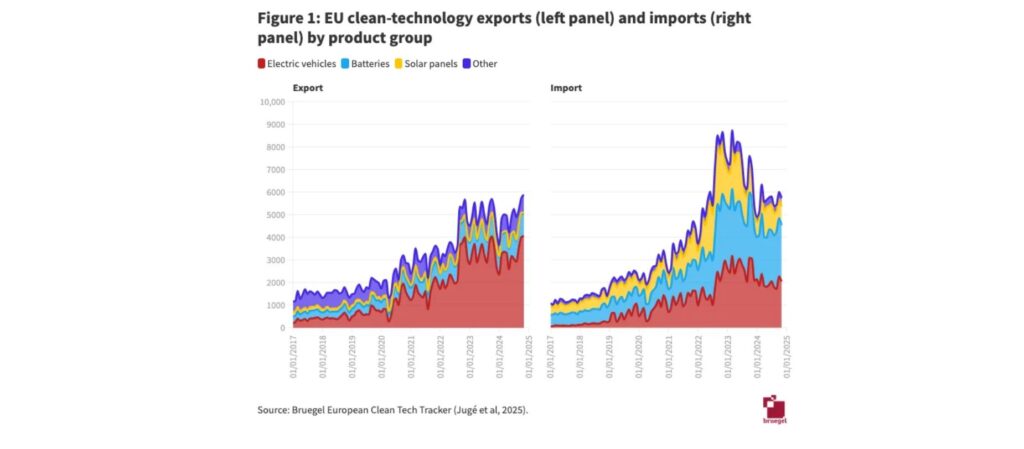
Last but not least, current levels of European public and industrial investment in green technological capabilities remain insufficient to match the scale and speed of China’s industrial policy. Broader international cooperation and the pooling of financial and industrial resources with like-minded partners may therefore be necessary not only to accelerate the clean transition, but also to counterbalance China’s growing market power in strategic net-zero sectors, while sharing and mitigating the costs and risks associated with indirect electrification and the development of clean value chains. This would also contribute to reshoring and the development of alternative markets for energy security purposes, as well as to the construction of value chains that inherently require continuous and stable integration across upstream, transport, and downstream segments.
In October 2025, the Joint Communication on EU global climate and energy vision framed the external dimension of the Clean Industrial Deal as a comprehensive geo-economic and geopolitical strategy, structured around ten key actions. At its heart lies the ambition to preserve EU leadership in implementing the Paris Agreement by reinforcing multilateral cooperation and accelerating the global deployment of renewables and energy efficiency.
Building on an extensive ecosystem of partnership instruments, the strategy seeks to externalise and scale up the Clean Industrial Deal by supporting European firms abroad, mobilising investment through Global Gateway and innovative financial tools, and strengthening resilient green value chains through trade agreements and international standards. This is complemented by an already well-developed diplomatic and cooperation toolbox, including high-level climate dialogues, Green Alliances and Partnerships, Just Energy Transition Partnerships, and EU Climate Dialogues, all designed to foster policy coordination, finance mobilisation, and knowledge exchange.
A second pillar deepens regulatory and industrial cooperation with partner countries, while also promoting reforms of the global financial architecture to unlock capital for the green transition, with particular attention to adaptation needs in the most vulnerable regions.
Finally, the strategy introduces a clear environmental dimension, linking climate change to fragility and conflict risks associated with the energy transition. While this builds on the climate–security nexus already outlined in the 2008 Solana Report and further integrates it into the Clean Industrial Deal framework, it also reveals a potential tension: if clean technology value chains with partner countries are not developed in an equitable manner, they risk reproducing the very “threat multiplier” dynamics of the climate crisis that the energy transition is meant to mitigate.
The Hidden Costs of the Green Transition: Environmental (In)security and Green Colonialism
While Germany has been the leading EU Member State in promoting clean technology value chains, I had the opportunity in 2024 to attend a Parliamentary Evening in Berlin entitled “Energy Partnerships with the MENA Region: From Fossil Fuels to Renewables and Hydrogen?”. There, Moroccan climate justice expert Ouafa Haddioui cautioned against the risks of “green colonialism”, warning that, if not carefully designed, the green transition could end up disproportionately benefiting the Global North. In fact, given the comparatively low production costs of green hydrogen in renewable-rich regions such as North Africa, several EU policymakers – including Green Deal Deus Ex Machina Frans Timmermans – have promoted the vision of importing affordable clean energy from neighbouring regions and the Sahara to help meet the EU’s future energy demand (see also the Desertec project). In this perspective, Haddioui portrayed green hydrogen as a form of green extractivism, shifting environmental burdens – such as water depletion, land use, and social disruption – onto the Global South while enabling the Global North to decarbonise its own economy.
EU hydrogen diplomacy risks turning into a form of “green colonialism”, as it is largely export-oriented and primarily serves the decarbonisation needs of industrialised countries. As a matter of fact, the CID projects in Africa risk being misaligned with local development priorities (for a useful theoretical explanation see also the Environmental Kuznets Curve – EKC), particularly in a context where around 600 million people in Africa still lack access to energy and urgently need affordable, reliable electricity to meet basic needs – for instance, enabling children to study after sunset through basic lighting (more critical arguments can be found in “L’urgence d’électrifier l’Afrique”).
In already climate-stressed contexts such as that of many African countries, prioritising water-intensive hydrogen production risks reproducing patterns of ecological collapse seen elsewhere, most notably the Aral Sea catastrophe caused by large-scale Soviet irrigation megaprojects. In Africa, similar concerns are increasingly raised regarding fragile ecosystems such as Lake Chad in the Niger Basin. Likewise, the growing race for the much needed critical minerals may generate a renewed resource curse, illustrating how the CID’s external projection onto African countries risks becoming a threat multiplier for climate security itself.
Toward a Fair and Clear Cooperation Framework: The EU Critical Raw Materials Act (CRMA) and Clean Trade and Investment Partnerships (CTIP)
The Critical Raw Materials Act (CRMA) is the EU’s strategy to strengthen its supply of critical raw materials in a sustainable manner, aimed at countering unfair trade practices while ensuring respect for labour and human rights of the local population, as well as environmental protection. While the strategy usefully brings the issue of fair partnership back to the fore, it remains insufficient in fully clarifying relations with Africa and third countries, which would require a more comprehensive approach. It will also need to withstand the test of reality in contexts where governance is often too weak to ensure genuine environmental justice vis-à-vis large mining corporations. With regard to green partnership frameworks, the EU has recently developed a new instrument – the Clean Trade and Investment Partnership (CTIP) – which aims to build on and integrate the benefits of existing climate-related partnerships with third countries, while placing a stronger emphasis on the objectives of the Clean Industrial Deal and industrial decarbonisation. However, so far only one CTIP has been signed, between the EU and South Africa, and even in this case its implementation will need to withstand a reality-check test.
Conclusion
The EU has sought to build the external dimension of the CID around supposedly win–win partnerships, notably through the CRMA and the CTIPs. Yet, if poorly managed, these initiatives risk exacerbating environmental insecurity in Global South countries targeted for mining, energy, and green industrial projects, while also undermining the EU’s credibility as a global climate actor. This could in turn weaken the legitimacy the Union has gained through previous international stabilisation and humanitarian efforts aimed at protecting vulnerable populations affected by climate-related crises in third countries, such as in the Lake Chad region. At the same time, both instruments remain too recent for a definitive assessment, and the EU’s external CID strategy is still evolving, including the very definition of “clean tech” and the identification of commercially viable value chains.
To conclude, two conditions appear essential to avoid a trade-off between European energy security and environmental security in third countries: first, transparent and publicly accountable implementation under the CRMA; and second, CTIPs that support not only the export of low-carbon fuels, but also the development of full downstream industrial value chains in partner countries (eg. green steel instead of upstream low-carbon hydrogen), while also facilitating technological know-how transfer and enabling genuine clean industrialisation, rather than reproducing new forms of extractive dependency.
Explore more articles
Europe’s incomplete dream for green autonomy
The paracetamol to relieve the pain of a headache, the packaging to keep food fresh, and the tubing used in a hospital IV line, all originate from a barrel of crude oil. Numerous everyday products depend on fossil-based carbon and hydrogen molecules. While recent geopolitical shocks (e.g., Russia’s invasion of Ukraine, Iran conflict) have exposed Europe’s energy dependence, they have masked Europe’s dependence on fossil-based feedstocks for plastics and pharmaceuticals.
Read moreFrom Russian Gas to American LNG: Can the EU Balance Energy Security and Competitiveness?
In recent years, the European Commission has placed the competitiveness of its industry at the heart of its political agenda, as evidenced by a series of major initiatives from the Competitiveness Compass to the Clean Industrial Deal all designed to close the productivity gap with the United States and China.
Read moreHow The EU Soil Monitoring Law Misses The Security Picture
Soil plays a fundamental role as it is central to food production, climate regulation, biodiversity and the resilience of ecosystems. Yet, according to the European Commission, 60 to 70 percent of European soils are currently in poor health. A share that could reach 90 percent by 2050 if current trends continue. In response, the Soil Monitoring Law, the EU’s first harmonised legal framework dedicated to soils, entered into force in December 2025.
Read moreThe EU’s drinking water governance: mopping the floor while the tap is running
The European Union has some of the strictest water standards in the world, yet reliable access to safe water can no longer be taken for granted. Research conducted over the past fifty years has revealed that groundwater contamination is far more widespread and harmful than previously believed. Additionally, the ever-increasing contamination by anthropogenic pollutants—those caused by human activities, including hazardous chemicals that did not exist or were barely recognized as contaminants a few years ago—create risks for human health and the environment that remain widely underestimated. From PFAS and pesticide residues to microplastics, many of these contaminants are highly persistent, difficult to remove and enormously costly to recover from.
Read moreThe European Ocean Pact: A Momentum for Enhancing Maritime Environmental Security
On 9 June 2025, announcing the establishment of the European Ocean Pact, European Commission President Ursula von der Leyen spoke of the ocean in the following terms: It feeds us, cools us, and connects us to the world. […] The Ocean is still in crisis. Without action, we risk our future, directly linking life on Earth to the health of this wonderful natural space, and framing ocean protection as a matter of security.
Read moreThe Global Implications of the Clean Industrial Deal: Reconciling Energy Transition at Home with Environmental Security Abroad
The EU’s Clean Industrial Deal (CID), centred on industrial decarbonisation and net-zero value chains, necessarily requires a strong external dimension. Clean industrial production – from green hydrogen and low-carbon steel to batteries and critical raw materials – depends on interconnected transnational value chains that increasingly rely on near-shoring strategies and strategic partnerships with third countries, especially in resource-rich neighbouring regions.
Read more