


Honorine Meirlaen
From Russian Gas to American LNG: Can the EU Balance Energy Security and Competitiveness?
By Honorine Meirlaen - September 2026
Introduction
In recent years, the European Commission has placed the competitiveness of its industry at the heart of its political agenda, as evidenced by a series of major initiatives from the Competitiveness Compass to the Clean Industrial Deal all designed to close the productivity gap with the United States and China.
Among the many drivers of industrial competitiveness, access to affordable energy with predictable prices is one of the most critical. Yet European firms consistently pay more for energy than their American counterparts. This energy price gap stems from three interrelated factors: Europe’s structural dependence on imported fossil fuels, the way energy prices are determined and the costs associated with the EU’s decarbonisation agenda. Gas sits at the centre of this problem. It is not only a major component of Europe’s energy mix, but also a commodity that directly determines electricity prices across the continent, with the merit order unit system.
This post therefore focuses specifically on gas, analysing two instruments the EU has deployed at different points in time : the REPowerEU plan, launched in 2022 in response to Russia’s invasion of Ukraine, and the EU–US trade agreement on energy, worth $750 billion, concluded in 2025.
The central question is therefore whether this $750 billion deal, concluded amid growing pressure from Washington on Brussels, represents a genuine competitiveness gain or simply a transfer of strategic dependency.
The Competitiveness Problem: Why Energy Prices Matter
The energy cost gap between European and American firms is not a marginal issue: it is a structural competitive disadvantage. European companies pay two to three times more for electricity than their US peers, and four to five times more for natural gas. The consequences are concrete: energy-intensive sectors have seen a 10 to 15% decline in output since 2021, and a gradual relocation of production towards countries with cheaper energy is underway.
Several factors explain this price gap. First, Europe lacks natural resources and domestic production capacity. The European Union remains heavily dependent on energy imports, with 57 % of its needs in 2024 met by imports, primarily from fossil fuels. This creates vulnerabilities in global supply chains, which can be disrupted or become more expensive due to geopolitical tensions, logistical constraints, or market fluctuations in regions beyond Europe’s control. Recent events illustrate these risks: crises such as Russia’s war in Ukraine, instability in producing countries like Venezuela, and disruptions to key shipping routes notably the 2026 closure of the Strait of Hormuz.
Second, despite being the world’s largest gas importer, the European Union has limited collective bargaining power. It finds itself in a price-taker position, fully exposed to international market volatility. This vulnerability is compounded by the structure of the European electricity market: the merit order system sets the electricity price based on the cost of the last marginal unit of energy, typically gas. Under this system, electricity generators are ranked according on how cheap or expensive they are to run.
Generally, renewables sit at the bottom of this ranking as the cheapest and first to be used, while fossil fuels and gas sit at the top as the most expensive and last to be called on. The market price is then set by the cost of that last unit used. In other words: during periods of low demand that can be fully covered by renewable energy alone, the price of all electricity is set by cost of that renewable energy. But during periods of high demand, when renewable production isn’t enough to cover it all, the price gets set by the last, most expensive unit in the ranking which is often gas.
At the peak of the 2022 energy crisis, natural gas set electricity prices 63% of the time, despite accounting for only 20% of the EU’s electricity mix. This means that even when renewables are producing abundantly, electricity prices remain high and their low costs do not benefit consumers.
Finally, the EU’s decarbonisation targets are more ambitious than those of its main competitors, with a binding goal of at least a 55% reduction in greenhouse gas emissions by 2030 compared to 1990 level. By contrast, the United States has set a non-binding target of 50–52% relative to higher 2005 levels, while China only aims to peak emissions by the end of the decade. This faster transition places a greater short-term burden on European industry because companies must invest earlier and on a larger scale in energy efficiency, electrification, renewable power, low-carbon production technologies, and emissions compliance. Yet this transition also represents an opportunity: reducing dependence on imported fossil fuels could bring prices down and strengthen energy security. However, China currently dominates the markets, technologies, and supply chains of renewable energy. Europe therefore risks replacing one strategic dependency with another.
REPowerEU: Breaking the Dependency on Russian Gas
In the following, the focus is on the EU’s gas dependence, given its strong impact on electricity and energy costs through the merit-order mechanism. Concerns about Europe’s gas dependency are not new. As early as 2000, the European Commission’s Green Paper on Energy Supply warned of rising external dependency, particularly for natural gas, and called for a common strategy based on diversification, efficiency, and regional cooperation. However, the dependence on gas kept increasing and the share of Russian gas in European consumption climbed from 26% in 2010 to 47% in 2019.
Despite this early warning, relatively little changed between 2000 and 2021. The EU’s dependence on imported gas continued to increase, while Member States largely retained control over their own energy strategies. This is largely due to the structural tension between national interests and the difficulty of building a unified energy strategy. Indeed, Article 194 TFEU preserves each member state’s right to determine its own energy mix, effectively limiting supranational harmonisation and maintaining a fragmented governance landscape.
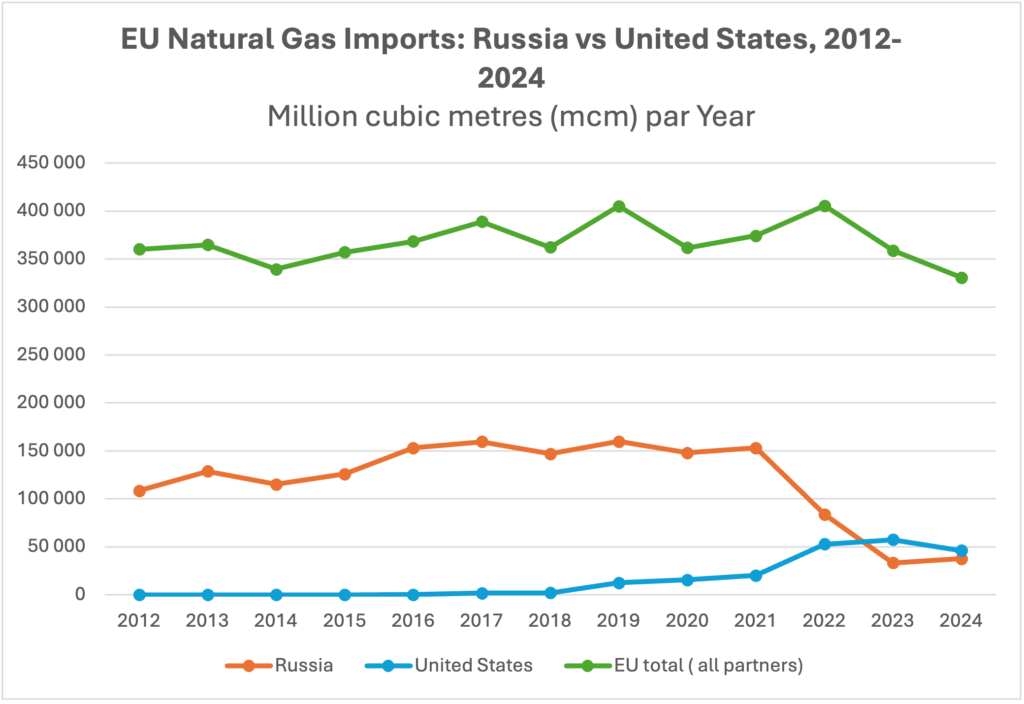
Against this background, Russia’s invasion of Ukraine in February 2022 constituted the decisive rupture. It triggered a much stronger European response because it transformed a long-term structural vulnerability into an immediate threat. Europe responded by launching REPowerEU, which redefined energy as a European common good and a geopolitical instrument. Its objective was explicit: end dependence on Russian fossil fuels through energy savings, supply diversification, and accelerated clean energy deployment. The impact was significant: net gas imports fell from 334 bcm in 2021 to 290 bcm in 2023, and Russia’s share of EU gas imports dropped from around 41% to just 9% over the same period. This substantial reduction in Russian gas dependence is illustrated in Figure 1 below.
To achieve these objectives, the dominant substitution strategy was a shift toward LNG, backed by a rapid expansion of import infrastructure. Between 2022 and 2024, 12 new terminals and 6 expansion projects came into operation, bringing total EU LNG import capacity to approximately 250 bcm per year. LNG’s key strategic advantage lies in its geopolitical flexibility: unlike pipeline gas, it can be sourced from any exporting country, allowing the EU to diversify suppliers and bypass the kind of fixed infrastructure dependency that Russia exploited.
Yet this flexibility comes at a cost. LNG is structurally more expensive than pipeline gas, and because it is purchased on global markets, the EU is now exposed to international price volatility. As we have seen above, since gas remains the marginal price-setter in electricity markets through the merit order mechanism, this volatility feeds through to the broader economy and so amplifying rather than resolving the competitiveness problem.
The EU–US Energy Trade Agreement: A New Strategic Dependency?
The EU–US energy agreement was negotiated in a tense transatlantic context. After the return of the Trump administration, Washington used the threat of tariffs and broader trade pressure to seek concessions from Brussels. The agreement was therefore not simply an energy contract, but part of a wider political and economic arrangement intended to stabilise EU–US relations.
Under the 2025 EU–US energy trade agreement, the EU commits to substantially increasing its purchases of American energy (including LNG, oil, and nuclear fuel) in a package estimated at $750 billion by end-2028. To put this in perspective: total EU energy imports in 2024 amounted to approximately $435.5 billion. Reaching $250 billion per year in American energy purchases would mean sourcing more than half of all EU energy imports from a single country.
The data in Figure 1 below shows the rapid development of US gas exports to the EU. Before 2016, no US natural gas deliveries were recorded in the dataset. US supplies first appeared in 2016 and increased substantially thereafter, reaching 57,487 units of total natural gas imports in 2023. These figures also show that US supplies to Europe consist almost entirely of LNG, as there is no conventional pipeline network connecting the United States directly to the European market.
The year 2023 marks an important turning point in the EU’s gas supply structure. Before 2023, Russia was the EU’s largest source of total gas imports. In 2023, however, the United States overtook Russia: US total gas deliveries reached 57,487 units, compared with 33,403 units from Russia. According to the projections cited by Jaller-Makarewicz, the US share could reach approximately 27% of total EU gas supply by 2025 and potentially increase to around 40% by 2030.
The shift was even more pronounced in the LNG market, in which US LNG accounted for 42.77% of EU LNG imports. The United States had therefore already become the EU’s dominant LNG supplier before the EU-US energy agreement was concluded. This agreement reinforces an already established trend by encouraging the EU to purchase larger volumes of American energy.
This is precisely where the central tension of the deal lies. The EU’s energy security strategy has been premised on diversification. The $750 billion deal with the US risks substituting Russia’s geographic stranglehold with a politically driven commercial dependency on the United States.
Furthermore, the geopolitical context in which the deal was struck, with Washington using trade threats and tariff pressure to extract concessions from Brussels, raises legitimate questions about whether this represents a genuine partnership or a commercially and politically asymmetric arrangement.
Conclusion
Europe’s energy transition since 2022 reflects a fundamental tension between security and competitiveness. REPowerEU successfully broke the dependency on Russian gas, but the dominant substitution strategy, a shift toward LNG, replaced one structural problem with another.
Three structural problems remain. First, LNG is more expensive than pipeline gas, and this price premium is passed on to European industry, exacerbating rather than resolving the competitiveness gap. Second, concentrating over half of EU energy imports on a single country replicates the logic of the Russian dependency it was supposed to replace. Third, the merit order system means that as long as gas sets the marginal electricity price, European industry will continue to pay for global gas market volatility.
The EU thus finds itself at a critical juncture. It has successfully reduced one form of dependency, but has not yet achieved the structural energy sovereignty that would truly underpin industrial competitiveness. The real answer to the competitiveness challenge lies not in finding a new dominant gas supplier, but in accelerating the clean energy transition that would ultimately decouple European electricity prices from global gas markets altogether.
Explore more articles
Europe’s incomplete dream for green autonomy
The paracetamol to relieve the pain of a headache, the packaging to keep food fresh, and the tubing used in a hospital IV line, all originate from a barrel of crude oil. Numerous everyday products depend on fossil-based carbon and hydrogen molecules. While recent geopolitical shocks (e.g., Russia’s invasion of Ukraine, Iran conflict) have exposed Europe’s energy dependence, they have masked Europe’s dependence on fossil-based feedstocks for plastics and pharmaceuticals.
Read moreFrom Russian Gas to American LNG: Can the EU Balance Energy Security and Competitiveness?
In recent years, the European Commission has placed the competitiveness of its industry at the heart of its political agenda, as evidenced by a series of major initiatives from the Competitiveness Compass to the Clean Industrial Deal all designed to close the productivity gap with the United States and China.
Read moreHow The EU Soil Monitoring Law Misses The Security Picture
Soil plays a fundamental role as it is central to food production, climate regulation, biodiversity and the resilience of ecosystems. Yet, according to the European Commission, 60 to 70 percent of European soils are currently in poor health. A share that could reach 90 percent by 2050 if current trends continue. In response, the Soil Monitoring Law, the EU’s first harmonised legal framework dedicated to soils, entered into force in December 2025.
Read moreThe EU’s drinking water governance: mopping the floor while the tap is running
The European Union has some of the strictest water standards in the world, yet reliable access to safe water can no longer be taken for granted. Research conducted over the past fifty years has revealed that groundwater contamination is far more widespread and harmful than previously believed. Additionally, the ever-increasing contamination by anthropogenic pollutants—those caused by human activities, including hazardous chemicals that did not exist or were barely recognized as contaminants a few years ago—create risks for human health and the environment that remain widely underestimated. From PFAS and pesticide residues to microplastics, many of these contaminants are highly persistent, difficult to remove and enormously costly to recover from.
Read moreThe European Ocean Pact: A Momentum for Enhancing Maritime Environmental Security
On 9 June 2025, announcing the establishment of the European Ocean Pact, European Commission President Ursula von der Leyen spoke of the ocean in the following terms: It feeds us, cools us, and connects us to the world. […] The Ocean is still in crisis. Without action, we risk our future, directly linking life on Earth to the health of this wonderful natural space, and framing ocean protection as a matter of security.
Read moreThe Global Implications of the Clean Industrial Deal: Reconciling Energy Transition at Home with Environmental Security Abroad
The EU’s Clean Industrial Deal (CID), centred on industrial decarbonisation and net-zero value chains, necessarily requires a strong external dimension. Clean industrial production – from green hydrogen and low-carbon steel to batteries and critical raw materials – depends on interconnected transnational value chains that increasingly rely on near-shoring strategies and strategic partnerships with third countries, especially in resource-rich neighbouring regions.
Read more